THRESHOLDS OF LIGHT & SPACE
The first things I remember are sensory rather than sequential. The feel of thick wool carpet under my hands and knees as I crawled around. The smell of oil paint, encountered before I had words for it and still fully present when I call it back even now. The smell of old books, which is called bibliosmia, some of which were centuries old, with pages filled with Latin, Middle English, and woodcuts, and the weight of language handled across generations. These are not memories I can date. They are simply there: not recalled but inhabited.
Space
I grew up in spaces where making, thinking, and looking were just accepted and ordinary. My grandparents’ heavy antique furniture had drawers filled with half-empty tubes of oil paints, rigid brushes, and boards; and tables and chairs that often carried beautiful painted faces of girlfriends or relatives on the undersides, hidden surfaces used when the canvas ran out and visible only to someone low enough, or small enough, to look up. Galleries, museums, country houses, and castles were visited frequently: places where time had accumulated in surfaces and objects, absorbed from the floor up, quite literally.
Solitude
There was also music from the very beginning of my life: from The Beatles to Bach, to polyphony, and to my uncle's 12-string guitar, records played on a small blue turntable that was mine from the age of five. And at the same age, I received my first telescope. I would spend hours in the garden watching the stars and the moon. As a child, I wanted to be only two things: a nun or an astronaut. One was about solitude and contemplative attention. The other is about extreme observation from the edge of what is possible. The practice I have ended up with contains both.
Language, sound, image, objects, houses and sky all appear in my work, and all are equally weighted. I did not learn to make connections between apparently unrelated things; I grew up in spaces where those connections were simply the texture of daily life.
Education
I was highly intelligent but never academic. School was something to endure rather than inhabit, and I left without going to university. The education that shaped me happened elsewhere: in old houses, in galleries, in making things, in reading, in music, in sustained attention to the world. My friend and I spent Saturday mornings working in my family’s private studio, where we prepared surfaces and drifted through the twelve vast rooms with their bare floorboards and peeling Edwardian wallpaper; I can still smell the dust and turpentine. We were each paid £15 in cash, and once the work was finished, we would take our pay and our pocket money and spend the afternoon buying clothes and records. That too was part of the education: the rhythm of work and freedom, and the unglamorous reality of creative practice before I understood that was what it was.
Recognition
At forty, I was diagnosed with what used to be called Asperger’s Syndrome. By then, I had created a helicopter training consultancy, was raising a young family, and was developing an interior design practice; it was a frightening time as I had no framework for understanding the intensity of my experience of the world. The diagnosis did not change what I could do, but it did clarify how I had always done it: pattern recognition, deep focus, acute sensory attunement, and an instinct for structural connection. These were not incidental to the work. They became it.
Scotland
I came to live in Scotland by accident. My husband was made redundant from the City just before a planned holiday to the Highlands. We drove north, found an extraordinary schoolhouse in a remote glen by chance, and within two months had packed up our lives and moved. That was almost thirty years ago. The accident became a choice, and the choice became a life.
The Highland landscape demanded a very different quality of attention from London. The clarity of light; the way weather moves through it; the way darkness falls completely in ways it does not further south; and the threshold between visibility and its absence. Slower. More measured. Less interested in the statement and more interested in what is actually there.
Silence
Practising Vipassana, days of silence without interaction with people, media, or writing, has deepened this further. The discipline of non-reactive observation has become part of my direct experience. Central to this is impermanence, anicca. It is the recognition that everything is in constant change. Light shifts, weather passes, forms appear and dissolve: what is seen is never constant. My work moved away from image-making towards attention itself: to atmosphere, to transition, and to the threshold where the visible world is already becoming something else.
Studios
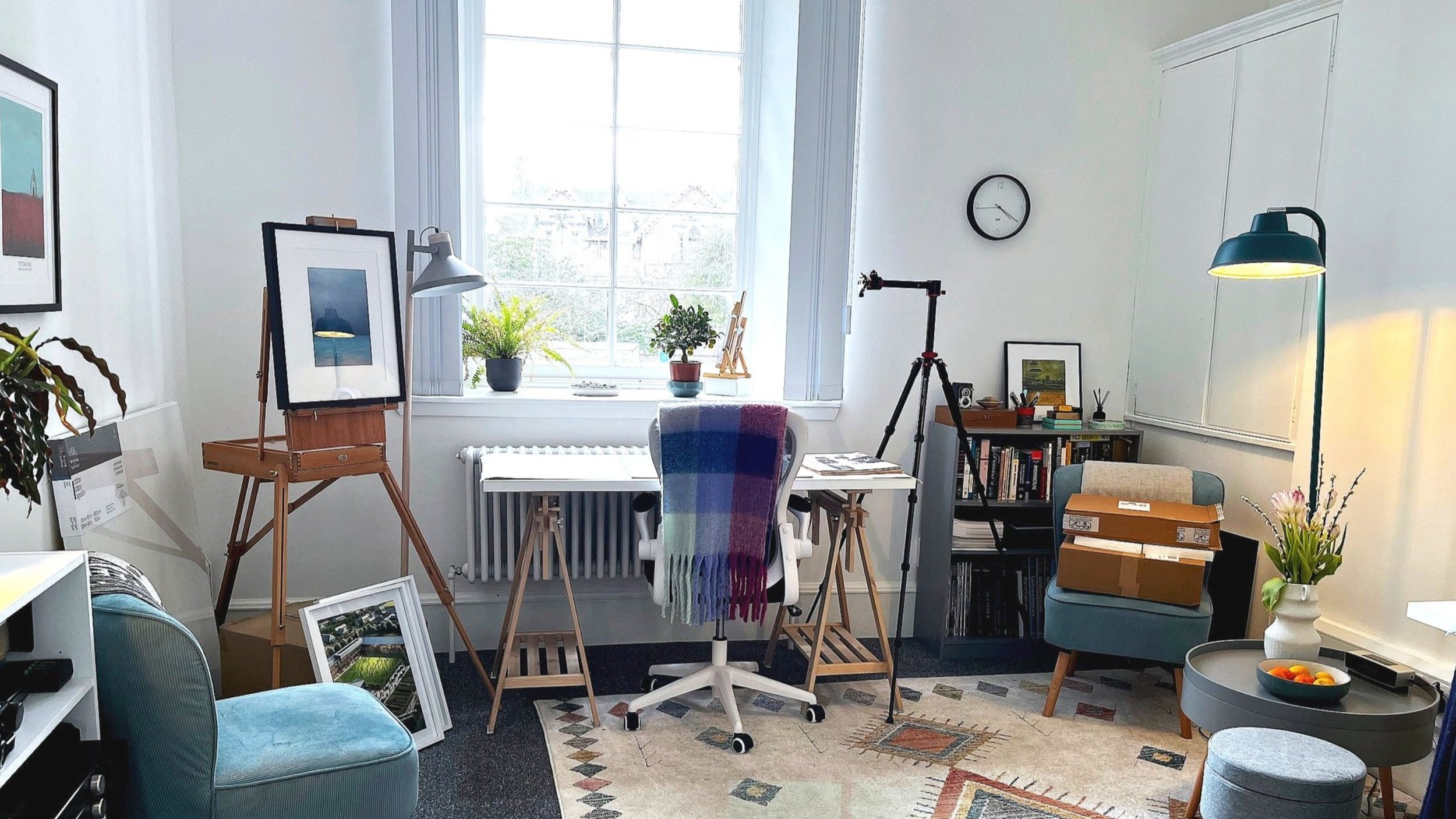
WASPS Inverness Creative Academy is my professional base, where I have worked since its opening in 2019. I have a small studio where I paint, and the former rector’s study is now my office, where I write and develop my creative and research work. WASPS stands for Workshop and Studio Provision Scotland, or as my daughter says, “We Are Special People”.
Stars
I am a Fellow of the Royal Astronomical Society and a Fellow of the Royal Society of Arts. My interest in dark skies work sits at the intersection of my art and writing practice, environmental and ecological awareness, and observational astronomy. I advocate for the protection of starlit nights, not as the removal of light itself, but as a considered approach to darkness and how we illuminate shared spaces and heritage sites. Civic spaces at night where people feel safe, but where nocturnal life flourishes, and where the Milky Way and Aurora Borealis remain visible.
Practice
My work is held in private collections worldwide. I am a member of Visual Arts Scotland, and a preferred artist of the Visual Arts Association. I have served as Treasurer of the Scottish Artists Union, as Secretary of the Highland Astronomical Society, Director of the General Aviation and Manufacturers Trade Association, fundraiser for the RNLI Loch Ness Lifeboat, STEM Ambassador for UHI, and Membership secretary for the Inverness Darkroom. These roles reflect an ongoing interest in community, art, and science.
I am currently preparing work for Nightlife, an exhibition of new and unshown pieces by artists and scientists, opening at WASPS Inverness Creative Academy from 24th February to 6 March 2027.
If you would like to discuss my work or find out more, I would be very glad to hear from you.
Live simply, travel lightly, tread softly.