

PROTECTING OUR DARK SKIES
Creative Research on Light and the Potential Loss of Night
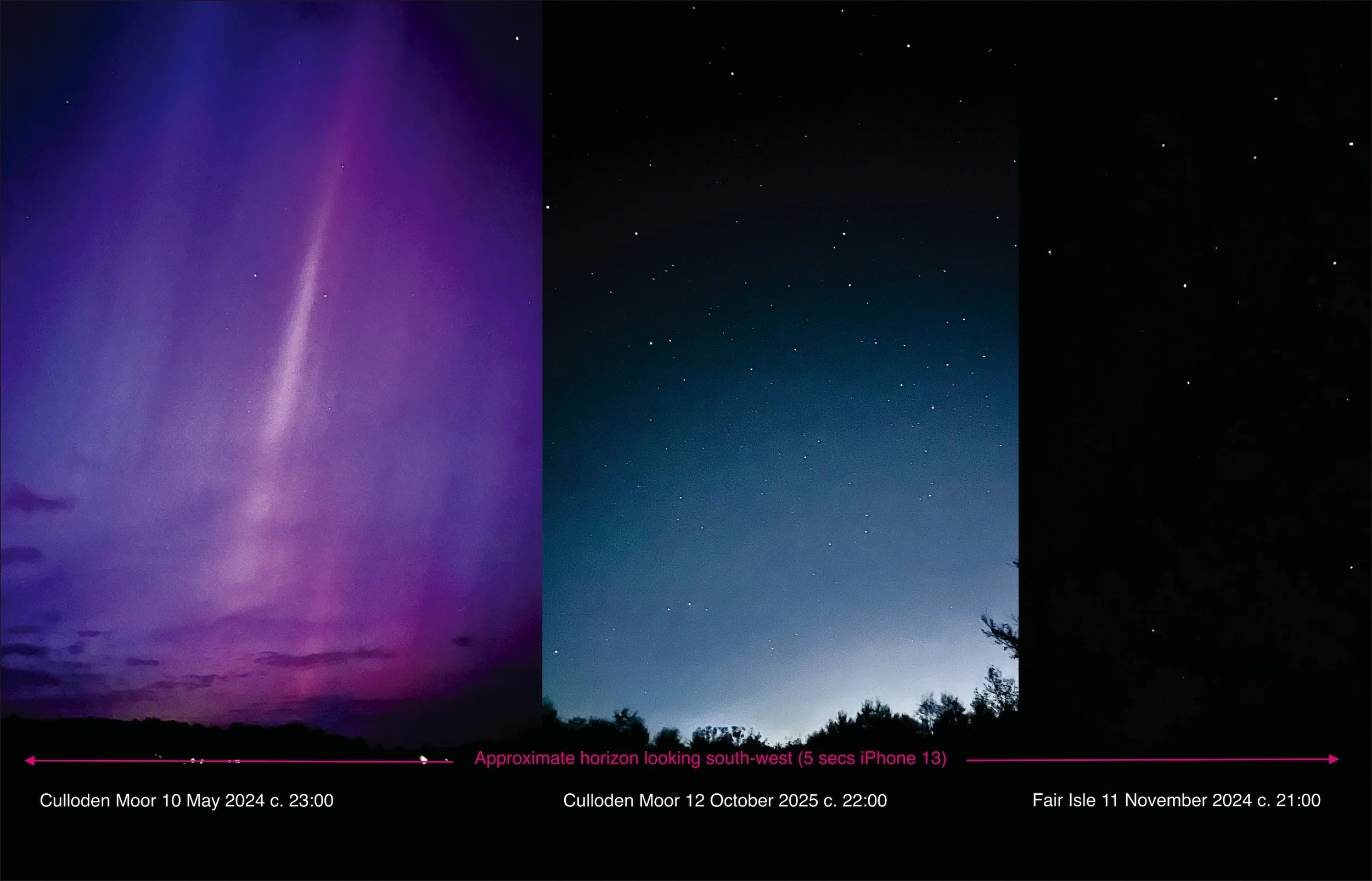
Creeping light from Inverness v Fair Isle.
Dark skies, responsibly considered
My interest in dark skies is rooted in good lighting design, not in the pursuit of darkness at all costs.
Starry skies can still be enjoyed in places that are sensibly and safely lit, including areas with street and road lighting. Darkness is not an all-or-nothing condition, and star gazing does not require the removal of everyday illumination. Many people encounter and enjoy the night sky from towns, villages, and roadside locations where lighting is present but thoughtfully designed.
Dark skies matter for observational astronomy, ecology, and our sense of connection to the night. However, they must always be balanced with public safety, accessibility, and everyday human use of shared spaces. Roads, junctions, paths, and public areas should be appropriately lit, particularly where there is known risk or regular pedestrian use.
I do not support the idea that darkness itself is a virtue, nor that watching the night sky should override safety considerations. Well designed lighting — warm in tone, carefully directed, and proportionate to context — can protect night skies while also improving safety, comfort, and inclusivity.
My approach aims to be pragmatic, evidence led, and rooted in community responsibility. Dark sky awareness should enhance places, not make them less safe or less welcoming.
Work from my Dark Skies project is within a wider public and creative research context and allows me to share and expand the conversation around darkness, excessive light and unnecessary light pollution, and our changing relationship with the night. It offers a chance to connect with astronomy and environmental groups, artists, scientists, and decision-makers through the shared concern of protecting the night sky while ensuring that used landscapes, are still safe.
Safeguarding darkness within the context of lived environment has become an essential part of my creative and ethical practice. Exhibiting and speaking about this work strengthens my ability to advocate for dark-sky awareness through art, while opening dialogue at civic safety, securotu, cultural, and ecological levels. My aim is to position the Highlands and Scotland more broadly as places where creative practice and environmental responsibility meet.
Developing this work further will also support future residencies and collaborations across Northern Europe, where dark-sky and light-pollution research are increasingly active. Building these connections extends the reach of my practice and situates Scotland’s creative voice within a wider international network concerned with night, light, and environmental awareness.
On a personal level, this ongoing work helps me explore new ways of combining visual and participatory practice, expanding my understanding of how creativity can shape public engagement and safety around the night sky. It will also allow me to build meaningful relationships with others working in this field.
Phase one: public outreach: Wasps Open Studios, Inverness, December 2025
The first phase of public outreach will be conducted via the Wasps bi-annual public openings at the Winter Market and Open Studios, which will be a precursor for the launch of the Dark Sky series scheduled for 2026. My formal launch will involve a selection of freebies, information boards, and small items that can be purchased as gifts or for personal use; I hope this gets the conversation started in an accessible, fun way.
These include:
stickers to give to visitors to my stand and studio during public events.
printed greetings cards, with hand-drawn constellations in the shape of recognisable objects (for the Christmas markets, these will include a reindeer, gift, or stocking, etc.)
silicon stamp to be used on post and parcels sent to patrons.
small plain notebooks, entitled Dark Skies Field Notes. These feature a cover displaying a selection of well-known constellations, and inside is a facsimile of the Bartholomew celestial hemispheres, accompanied by a template for recording dark sky observations.
bookmarks, printed on the reverse with quotes about stars by writers such as Tolkien, George MacDonald, Mark Twain, etc.
hand-blended rare inks inspired by songs about stars, the sky or space
There will also be a selection of other small works related to the sky, for example, cyanotype prints, paintings and sketches.
I am currently researching exhibition spaces for my larger body of dark sky work for 2026. These small pocket money pieces are a precursor to my larger, more serious works and are designed to act as conversation starters.
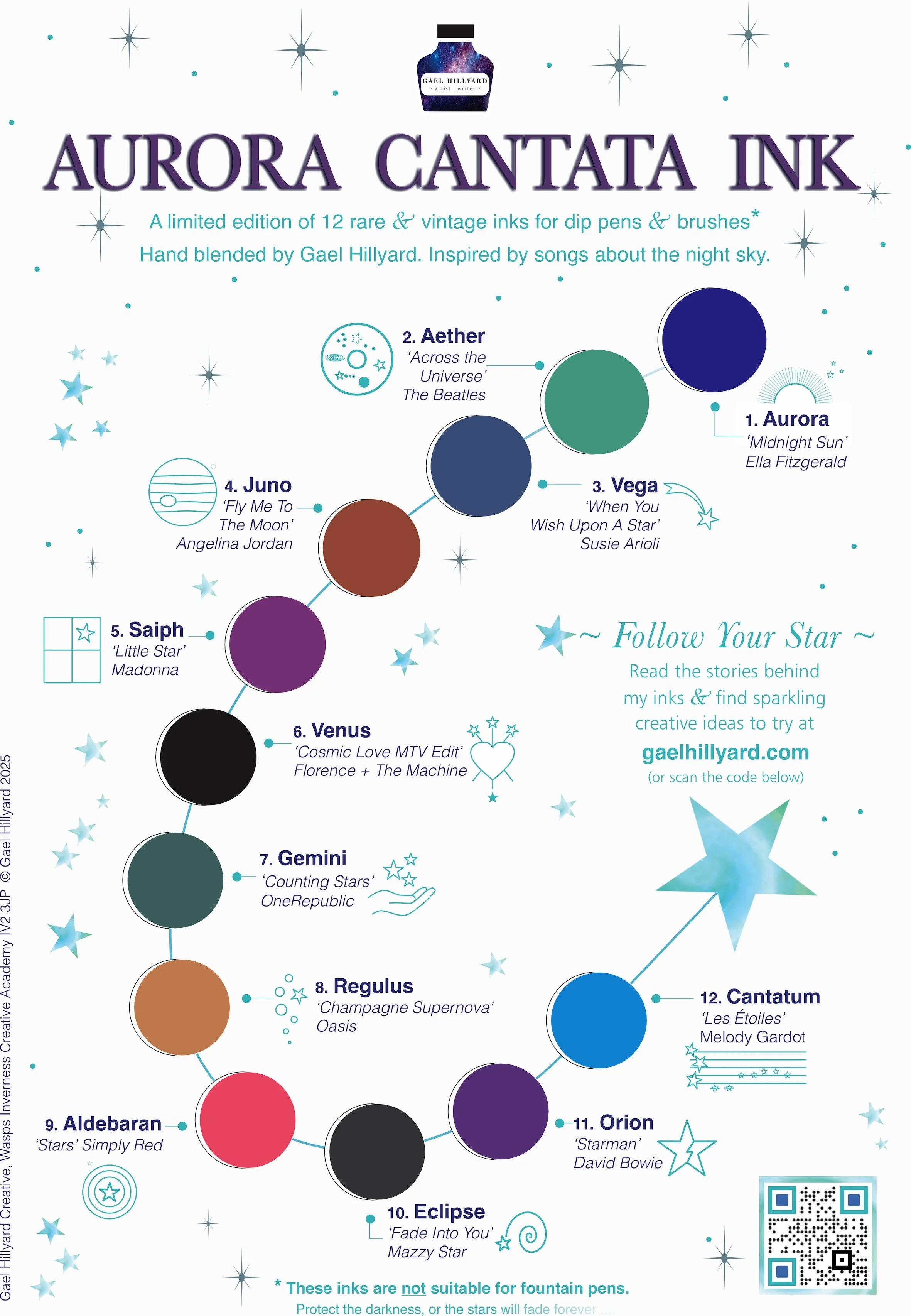
A3 swatch board for my pop up and open studio.
These inks are a gateway that people can use or gift that will hopefully start a conversation (I also sell dip pens and nibs to go with them at almost cost price, as well as the field notebooks).
My inks always draw attention and are very popular, and I felt this was a good way of engaging a potentially new audience.
During the open studios event I intend to have playlist in my studio that will consist of just these songs, with a sparkling starry music added between tracks to push it past a one-hour duration.
For a little added interest, a free PDF is available that describes the background to the constellations and astronomical info that inspired the inks. This can be found here.
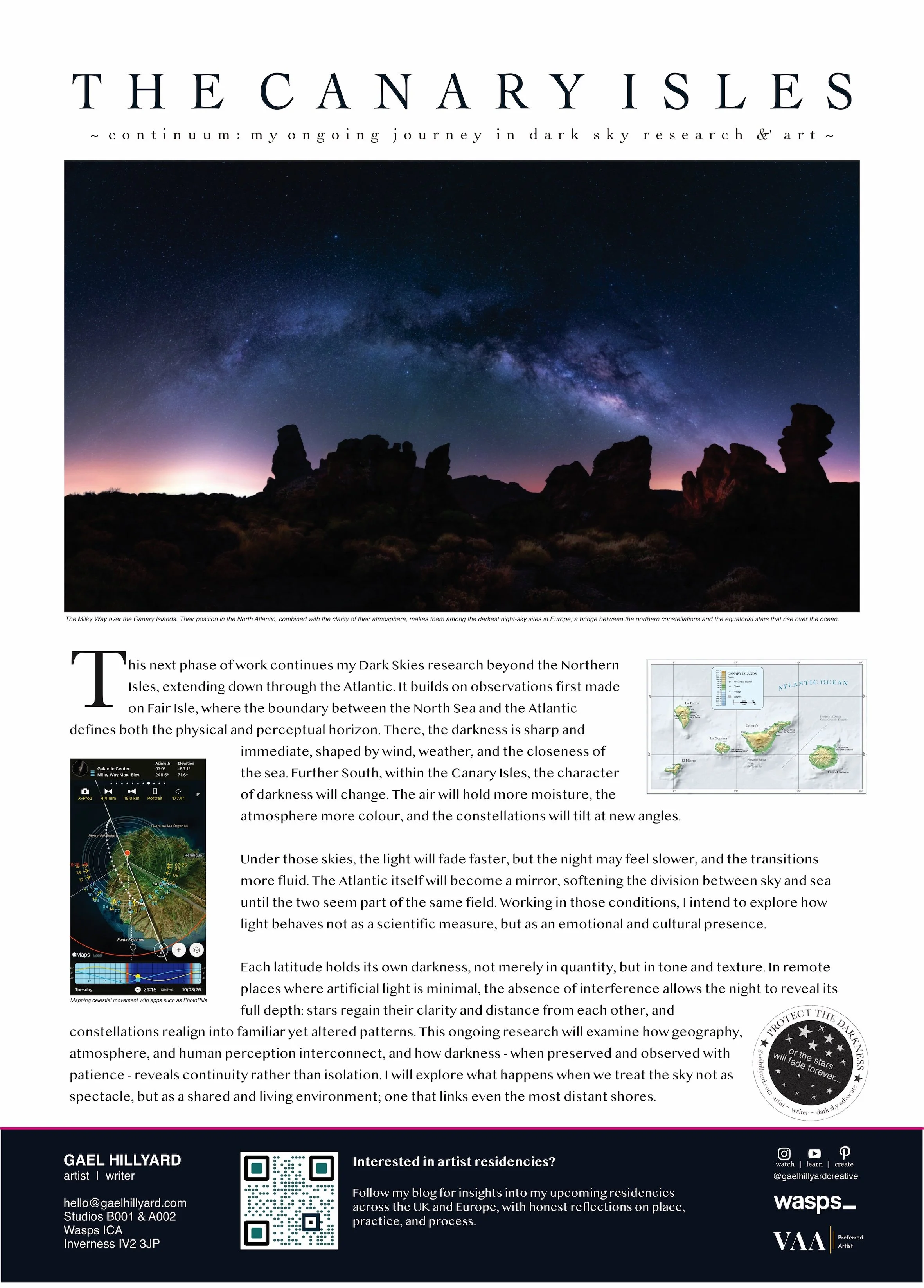
Phase two: residency La Gomera, Canary Islands, Spain - 1st March to 30 April 2026
Phase three: exhibition of work. Venue and dates to be confirmed
The third phase involves an exhibition of work, including paintings and photographs. I am currently researching exhibition and gallery spaces in the Highlands, and around Scotland and London.
Once I have secured the best space, the exhibition will include paintings and works on paper from my ongoing Dark Skies series. The collection explores light, atmosphere, and perception within the Highland night, reflecting how the sky reveals both its beauty and fragility when free from interference, and how this balance is changing through the spread of artificial light.
Alongside oil and mixed-media paintings on canvas, the exhibition will include framed watercolours and ink illustrations. The watercolours offer a looser, more spontaneous response to the same subject, while the ink drawings focus on astronomical form, diagrams, and the patterns of artificial light seen from the ground. Together, they form a conversation between direct observation, abstraction, and the language of mapping.
The palette is varied rather than dark, with areas of vivid colour suggesting aurora, planetary light, and the chromatic traces of nebulae. Some works also depict the warmer tones of urban illumination, reflecting the contrast between natural and artificial light in the Highland landscape. Surfaces are built through translucent glazes, layered texture, and the occasional inclusion of found or natural materials to convey depth and presence.
The exhibition will be accompanied by a short talk at the preview and a workshop on capturing the night sky through painting and observation. A separate talk will address light pollution and its broader ecological and cultural impact, developed in collaboration with local astronomy groups.
Before the exhibition period, I plan to hold an evening Dark Sky Workshop at WASPS Inverness Creative Academy. February, as this provides full astronomical darkness from around 8 pm, making it possible to combine an indoor session with outdoor observation on the same evening. The workshop will bring together telescopes, binoculars, and members of the local community for shared viewing and discussion. It will take place subject to weather conditions and the necessary risk assessments.
Interest in the night sky continues to grow, and events of this kind have a broad appeal to audiences beyond the visual arts. The subject offers an inclusive way to engage people who might not otherwise visit an exhibition, and the topic is especially important in the centre of Inverness, where light pollution often limits public connection with the night sky.
As I have secured a residency in the Canary Islands as a Bortle 1 - 2 location, I will arrange for a larger exhibition in Edinburgh, Glasgow, or London.

The Diminishing Night, oil on canvas (C) Gael Hillyard
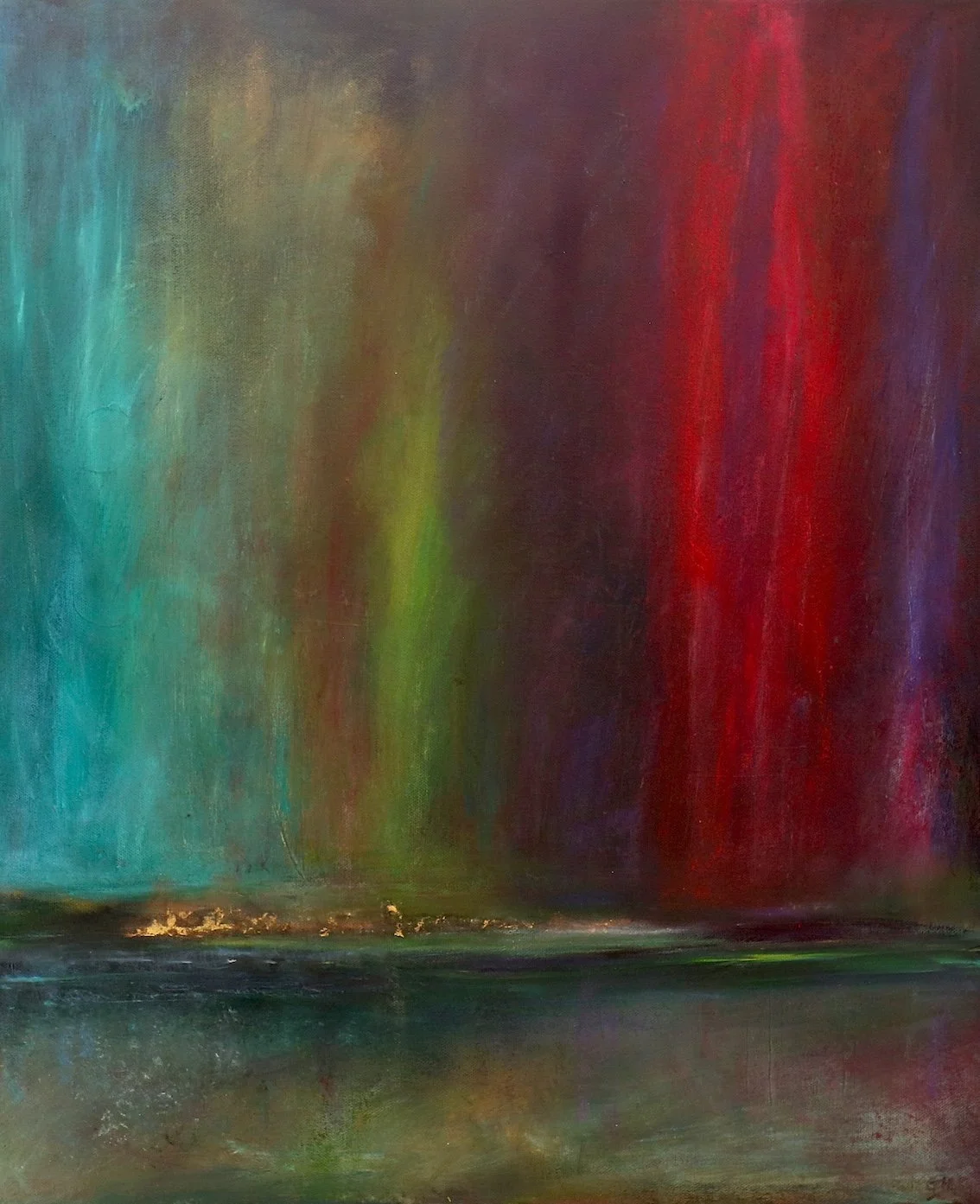
Detail from Aurora Over Lerwick, acrylic, oil and 24 ct gold on canvas
(C) Gael Hillyard. Used as Artmags Scotland cover in July 2025
Astrophotography
I intend for my exhibition to include a selection of high-quality astrophotography created using professional cameras, intervalometers, and sky trackers. These works demonstrate the extraordinary objects and colours that become visible when the night sky is captured through long exposure and precise tracking.
I am also researching digital cameras that can be loaned to local groups to raise general interest in night sky observing. I believe this is an important aspect of my outreach approach as it encourages participation in the topic while removing the need to travel to darker, and often more difficult to access locations, especially in Winter. As these devices are aimed at capturing deep space objects instead of the moon or planets, I see them as a gateway to the broader field of astronomy, and as wonderful tools for getting people to look at the night sky; hopefully this will lead to greater knowledge, and any loans to local groups and schools will be accompanied by observing techniques and a ‘bingo card’ type leaflet to check off seen objects.
However, the spirit of the project is not about technology, but connection and I would like to show you do not need specialist equipment to begin exploring the stars. While I can work with professional gear, much of my work has been done using an ordinary iPhone with a five-second exposure, and most modern phones can achieve astonishing results with very little adjustment.
To make local stargazing more accessible, therefore, I am designing a simple cardboard light shield that can be made at home for pennies. The downloadable pattern will be free and will print on A4 paper so it can be traced onto a piece of recycled card. It fits around a phone to block the glare of nearby streetlights, helping the camera capture more stars from the local street or garden. It also serves as a small creative project that families can make together, and something tactile that makes capturing the night sky a little easier.
I want to show that sometimes the most meaningful connection to the night sky begins not in a remote landscape, but right outside your front door.
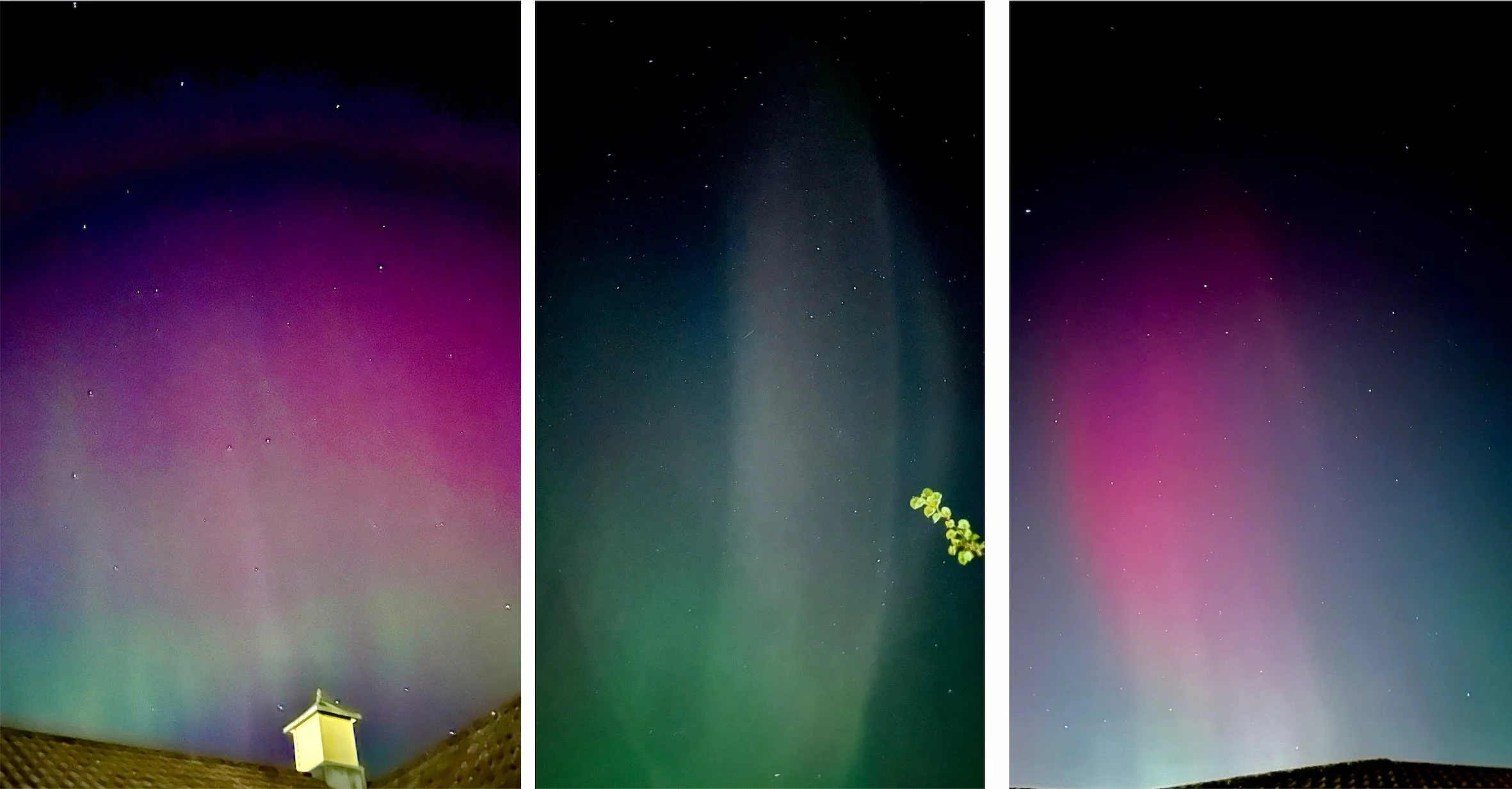
Captured from suburban Inverness, these images show the night sky illuminated by aurora, and, at the centre, possibly an example of STEVE (Strong Thermal Emission Velocity Enhancement), a potentially rare atmospheric event. They reflect how moments of celestial beauty can still be witnessed from light-affected environments. But these are rapidly being lost to increasing illumination.
Conclusion
At the heart of Dark Skies is my own relationship with night, light, and the sense of belonging that darkness can restore. This work is as much personal as it is collective and is rooted in my experience as an artist who lives and works in the Highlands and who has seen how excessive and poorly managed light affects not only the land but also the mind and spirit. Darkness connects ecology, heritage, and wellbeing; it shapes how we understand our environment, our history, and our place within it, but it needs to be balanced with our sense of security and place
By exploring these ideas through my own creative practice, I aim to show that while protecting the night is not only an environmental concern but a cultural and social one, it is also essential to view this in the context of personal security and safety which in themselves support mental health, the rhythms of wildlife, and the preservation of our shared heritage. My role is to hold these threads together in order to translate science and advocacy into something human, visual, and resonant. Through Dark Skies, I hope to help people see that safeguarding darkness while allowing light to carefully do its work is an essential means of safeguarding ourselves and our planet.
The Important Footnote: Protecting The Skies in the Scottish Highlands
The Scottish Highlands are one of Europe’s last sanctuaries of natural night. Yet this darkness, once a defining part of life in the Highlands, is fading under the pressure of excessive artificial light, over-illuminated urban development, and the rapid expansion of satellite constellations.
The ecological, cultural, and spiritual importance of darkness is profound; however, there is growing evidence that excessive and poorly designed artificial light at night (ALAN) disrupts the rhythms of pollinators, birds, bats, and plants, while diminishing astronomical observation and severing a connection to the stars that has shaped humanity for thousands of years.
Pollinator Crisis: Research shows that meadows lit at night receive 62 per cent fewer nocturnal pollinator visits, resulting in reduced seed and fruit production (Nature, Knop et al, 2017).
Ecological Instability: Lighting fragments habitats, alters migration patterns, and accelerates insect decline.
Astronomy Under Threat: Sky brightness is increasing at around 10 per cent annually, worsened by satellite constellations leaving visible trails across the sky (Science, Walker, C. E., et al, 2023)
Highland Leadership: Community projects, such as the Abriachan Forest Trust and the Highland Astronomical Society with its Observatory on Culloden Moor, demonstrate how darkness can be an ecological asset, a cultural resource, and a source of sustainable tourism.
A Call to Action: Scotland can lead by adopting dark sky lighting codes, creating dark-sky infrastructure and wildlife corridors, and treating darkness as an ecological asset.
Darkness is not about the total absence of artificial light. It is a carefully balanced and designed infrastructure that enables safety and security and protects biological and civic necessity; this type of darkness is a rhythm that has both shaped humanity’s imagination and knowledge but allows us to live comfortably in the 21sr century. To lose the stars is to lose a mirror of ourselves. But to lose at least some light is to lose our sense of place. The Highlands still hold the treasure of completely dark skies, but its future must also include responsibility and conscious stewardship.
About WASPS ICA
WASPS Inverness Creative Academy is my professional base, where I have worked since its opening in 2019. I have a small studio where I paint (the smallest in the whole Wasps’ Estate), and the former rector’s study is now my office, where I write as well as plan my ongoing creative and research work. WASPS offers dedicated studio and exhibition space to Scotland’s network of artists and creative industries across numerous beautifully restored buildings. WASPS stands for Workshop And Studio Provision Scotland, or as my daughter says, “We Are Special People”!
(C) Gael Hillyard 2025. All rights reserved.